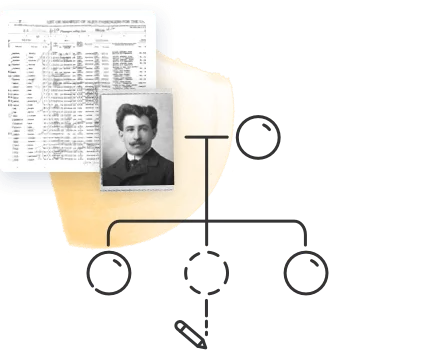
Even the most meticulous family historian can lose the thread of a lineage. A pedigree chart brings order to the chaos by laying your direct ancestors out in a clear, intuitive format. It’s one of the most common methods of organizing genealogy information, allowing you to visualize your direct ancestral line. Most family trees are curated as a pedigree chart, making it easier to understand your connections to family members, track surnames, and spot potential gaps in your research.
At MyHeritage, you can explore your family tree in a dedicated pedigree view as you build it, and you can also generate printable charts in a classic pedigree format — both designed to give you a clear, easy-to-follow overview of your direct ancestral line. Learning how to use a pedigree chart is one of the best ways to start your genealogy journey. Read on for more advice on how pedigree charts can make it easier to record, share, and update your family tree.
Key takeaways on pedigree charts
- Pedigree charts are a visual tool for tracing your direct ancestors, linking each generation through your parents and grandparents.
- Most amateur and professional genealogists use pedigree charts to organize their research, making it easier to share with family members and collaborators, while also spotting potential gaps.
- While you can create a physical pedigree chart, platforms like MyHeritage will automatically generate your pedigree chart and update it as you confirm family matches and potential ancestors, slotting them into the correct spot.
- Digital pedigree charts make it easy to keep track of your research by automatically assigning documents, information, and dates to specific individuals.
What is a pedigree chart?
A pedigree chart is a structured way of displaying an individual’s direct lineage, including parents and grandparents. It also forms the basis for a wider family tree by using optional branching to showcase other ancestors and relatives, including cousins, great-aunts, and great-uncles.
Every pedigree chart starts with the individual as the root, which will typically be yourself or the person whose family tree you’re researching. These charts were first used to trace royal bloodlines, but are now widely used.
Each subsequent generation becomes a branch, showing how every member of the family tree is connected to the root through a specific ancestor. Digital pedigree charts are the most popular option as they’re interactive, making it easier to organize information and giving you an instant overview of the family tree. By comparison, paper pedigree charts are now typically used only for display or archival reasons.
Understanding pedigree charts
Pedigree charts use a generational format with the individual at the root starting as the first generation. Their parents create the second generation, with grandparents becoming the third generation, and so on. Traditionally, pedigree charts use squares to represent males and circles for females, allowing you to get an instant visual overview. Similarly, horizontal lines are used to represent marriage, while vertical and diagonal lines are used to show children.
There’s an important distinction to remember about pedigree charts vs. family trees. A pedigree chart tracks direct ancestors only, while a family tree branches out to include siblings, cousins, and other descendants of direct ancestors.
Why pedigree charts are important for genealogy
Pedigree charts are a foundational part of any genealogy study, offering clarity to your research by simplifying your data. Organizing your research with a pedigree chart can make it easier to identify missing records or errors that may result in generations wrongly overlapping.
One of the main benefits of pedigree charts is that they make it easy to collaborate with other family members and researchers when developing your wider family tree. With a MyHeritage account, you’re able to preserve your research with a pedigree chart and family tree that you can pass on to future generations.
Step-by-step guide: How to create a pedigree chart
Creating a pedigree chart is how most genealogy journeys begin. We’re giving a step-by-step breakdown of how to begin your pedigree chart and start your research.
- You’ll start by putting yourself – or the person whose family tree you’re researching – at the base or root of the chart.
- Next, you’ll add the full names, dates of birth, and place of birth for each parent.
- Start working backwards by adding grandparents and additional direct ancestors, using the information you already have.
- You can consult official documents, such as census records, birth certificates, and marriage records, to confirm your information. If you’re using a digital chart, you can assign these records to a specific individual.
- Whether you’re creating your pedigree chart by hand or using a digital platform like MyHeritage, it’s important to regularly update and confirm your chart with new results.
Your pedigree chart is the document you’ll consult most throughout your genealogy research, so it’s important to make sure it’s as accurate as possible. It’s best practice to verify your information before adding to your chart, including checking the spellings of names and even trying alternative spellings when searching for records.
For easy reading, you’ll want to see consistent formatting throughout your pedigree chart for names, dates, and places. You can also bring your pedigree chart to life by adding photos to help tell your ancestor’s story.
Join MyHeritage today to create your free pedigree chart
A pedigree chart is the key to starting your genealogy research, giving you an instant overview of direct ancestors, and providing the foundations for your wider family tree. Get started today with a free trial to digitize your pedigree chart and start exploring your family history.
FAQs about pedigree charts and how to use them
What’s the difference between a pedigree chart and a family tree?
Pedigree charts focus on the individual’s direct ancestors, whereas a family tree includes other relatives, such as cousins and the other descendants of direct ancestors.
Can I add adopted family members to a pedigree chart?
Pedigree charts are traditionally focused on biological relationships, but digital platforms often allow for including adopted relatives and stepfamilies.
How many generations are included in a pedigree chart?
Most pedigree charts show up to 6 generations, but there’s no limit to how many ancestors you can include in your MyHeritage pedigree chart.
Does MyHeritage automatically turn my information into a pedigree chart?
When you add relatives to your family tree and confirm potential matches, MyHeritage will automatically update the pedigree view of your family tree.
How can I verify the information in my pedigree chart?
Confirm the information you have for your direct ancestors by using historical records and assigning documents to everyone.